 Violin-making is sometimes called a glost art.h More than 300 years ago, Italian great violin maker Antonio Stradi-van succeeded in raising the craft of violin-making to the level of perfection. The master, however, died in 1737 without passing on the secrets of his acoustically perfect violins, even to his sons who as-sisted him.
According to modern re-search, factors such as a vio-linfs design, varnish, the thickness of front and back, and even the condition of mi-croscopic pores within the wood influence the beauty of the violinfs tones. However, to this day, no one has actually determined how to make violins as perfect as Stradivarifs.
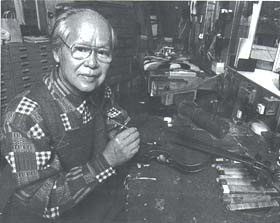
gViolins are full of mysteries, which keeps me fascinat-ed with violin-making,h says Chang Heryern Jin, a Korea-born violin craftsman who lives in Tokyo. Changfs vio-lins are highly esteemed and favored by many professional musicians. His newly pro-duced violins are priced at \1.5 million, but decades-old ones go for more than \3 million.
Chang was internationally recognized in 1976 when he was awarded the first prize in an international competition of violin- and cello-making in the United States. He earned five gold medals out of six categories in the competition, and was given the special title of Hors Concours & .Master Maker. There are only five craftsmen who hold the title in the world, and he is the on-ly Asian.
Chang came to Japan in 1941. After World War II ended, his family went back to Korea but he stayed here, and studied English literature at Meiji University while working at night for his living ex-penses and school tuition.
He was privately taking violin lessons, but gradually be-gan to realize the limits of his ability as a musician. One day he attended a lecture on the mysteries of violins, and instantly decided to become a violin maker.
After graduating, Chang visited several violin crafts-men in the country, asking them to accept him as an ap-prentice; however, due to his nationality, they all turned him down. When even a facto-ry of mass-produced violins refused to hire him, he gave up the idea of apprenticing.
While working during the day as a construction worker in Nagano, Chang started cre-ating violins at night, depend-ing only on an old English-lan-guage book titled gViolin-Making: As It Was, and Ish by Edward Heron-Allen.
The book taught him the basics of violin-making, but it did not explain how to make gclear, deep, soft and warm tones.h He experimented with all the possibilities he could think of - even what he saw in his dreams.
gInterestingly, ideas from my dreams sometimes worked out,h he says. gStill today, I keep a pencil and memo pad at my bedside, so that I can write down any dreams related to violins.h In 1962 Chang once again moved to Tokyo, and met a violinist/teacher who showed an interest in his handmade vio-lins. He ordered many violins from him, and also requested Chang to repair his own expensive violins. To repair those masterpieces, Chang was allowed to tak them apart and put their back together. It was an in valuable experience for thc craftsman. After dismantling those violins, he would examine each piece of wood closely, rubbing them with his hands and against cheeks, sniffing and even licking them.
Now he can instantly tell the quality of a violin or the problems to be modified by just holding the violin. It is not easy, however, to put intc words the subtle differences he can feel. Even his three sons/apprentices cannot fully understand what he tries to say, but he hopes they will in the near future, Chang says.
gThere are no geniuses in the world. You succeed in something only by maintaining curiosity and tenacity,h Chang says. gI think I have resolved five or six secrets [of violin-making], though those are not all of them. I think Ifm very persistent. I want to keep tackling the violinfs mysteries in the life after death, if there is such a thing.h
Chang Violin Studio, 2-37.12 Midori gaoka, Chofu City, (03) 3308-5550.